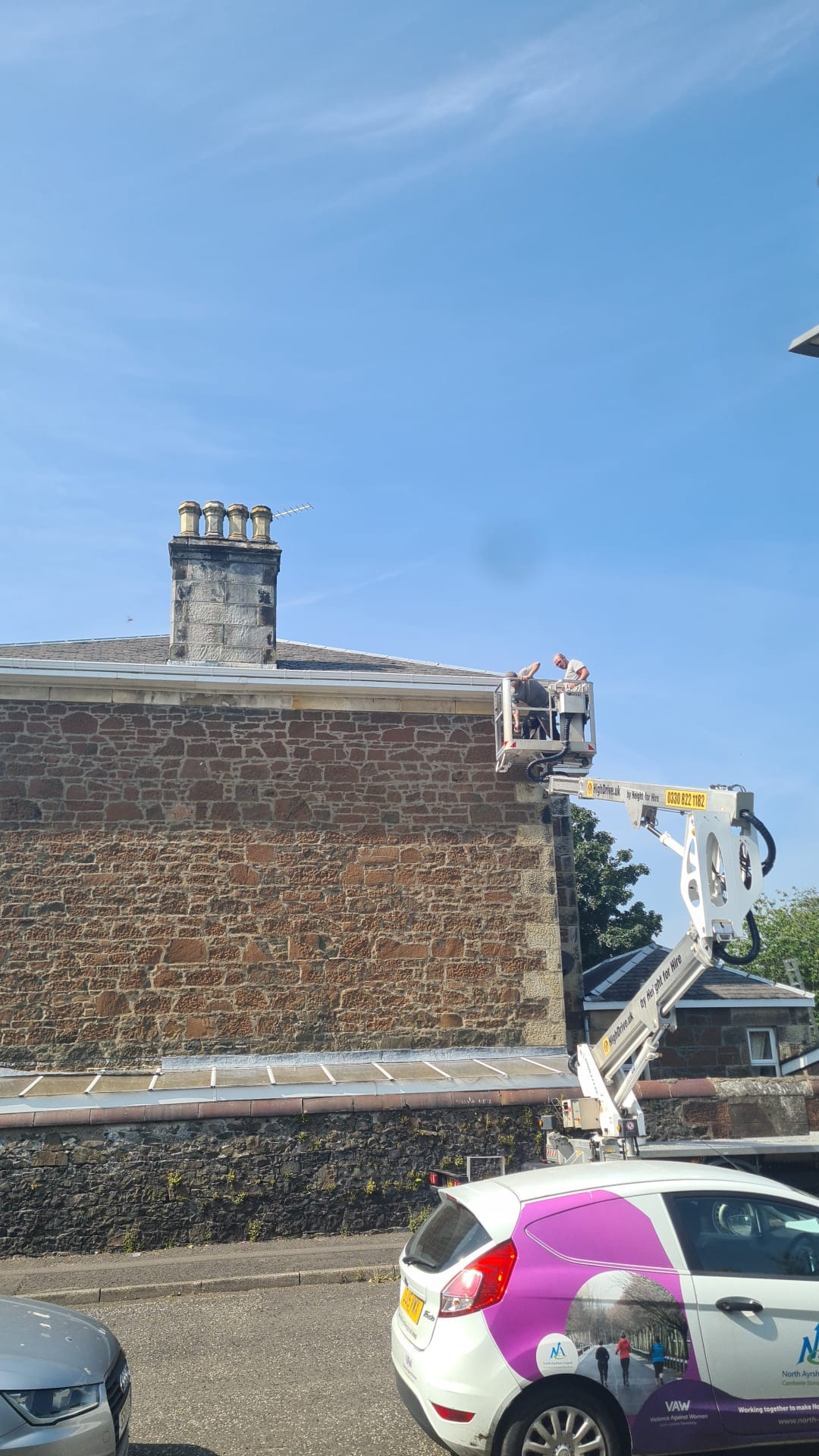
A brown mark on a bedroom ceiling can be worrying, but it rarely tells you where the roof is leaking. Water can travel along felt, timbers, pipes or insulation before it appears indoors, sometimes several metres from the actual fault. That is why proper roof repair leak detection matters: repairing the visible symptom without finding the entry point can leave the home exposed to the next spell of wind and rain.
For homeowners and landlords in Irvine and across Ayrshire, a roof leak needs practical attention rather than guesswork. Scotland’s wet, windy weather can quickly turn a small defect into damaged plasterboard, wet insulation, rotten timber or a more expensive repair. The right approach is to inspect the whole affected area, identify how water is getting in, and carry out a repair that suits the roof’s condition.
Roof repair leak detection starts outside
A reliable inspection begins with the roof covering and its details, not just the room where the damp patch has appeared. On a pitched roof, slipped, cracked or missing slates and tiles are common causes. A single displaced slate may be enough to let driven rain beneath the covering, particularly on exposed properties.
The areas where different materials meet also need close attention. Lead flashing around chimneys, roof windows, valleys and abutments is designed to direct water away from vulnerable joints. If it has lifted, cracked, split or been fitted poorly, rain can find its way behind the roof covering. Mortar around chimney flashings can deteriorate too, and an old chimney stack may allow water in through damaged pointing, failed coping stones or cracked render.
Flat roofs require a different check. Water may enter through splits in felt, open seams, damaged edges, failed joints around pipes, or standing water caused by poor falls. A flat roof can look acceptable from ground level while its surface has begun to break down. Small blisters or cracks are worth investigating before they become a larger opening.
Gutters, downpipes, fascias and soffits are part of the picture as well. Overflowing gutters can soak the roof edge and external walls, making it appear that the roof itself is leaking. Blockages, loose brackets and damaged joints should be dealt with, but a gutter issue should not be assumed to be the only cause without checking the surrounding roofline.
Why the damp mark is not always the leak location
Inside the loft, signs such as wet insulation, darkened timber, drips on roofing felt or a musty smell can help narrow down the source. However, a visual check still needs care. Condensation can be mistaken for a roof leak, especially in poorly ventilated lofts where warm household air meets a cold roof surface.
The pattern of the problem offers useful clues. A leak that appears only during heavy rain and strong winds often points to a fault in slates, tiles, flashings or a roof junction. Damp that develops gradually in cold weather, with widespread moisture on the underside of the roof, may be more closely related to condensation and ventilation. In some homes, both issues are present.
Water staining near a chimney does not automatically mean the flashing is at fault. The chimney itself could be taking in water, or a defect higher up the roof may be directing water towards that area. Equally, a stain close to an outside wall could be caused by overflowing guttering, defective roughcasting or a problem at the roof verge. This is why a full external inspection is more useful than replacing a piece of flashing on assumption.
Common roof leaks in Ayrshire properties
Many homes across Ayrshire have roofs that have dealt with years of rain, frost and coastal winds. Age alone does not mean a roof needs replaced, but worn details should be repaired before weather gets behind the covering.
On traditional pitched roofs, common faults include loose ridge or hip tiles, cracked slates, perished underfelt, damaged valleys and failing chimney mortar. On newer tiled roofs, broken tiles, poorly secured verges and worn seals around penetrations can be the weak points. Storm damage may be obvious, but gradual movement and weathering are just as common.
Older roofs can also have more than one issue. For example, a homeowner may call about a ceiling leak and discover that the guttering is overflowing, the chimney pointing has opened up and several slates have slipped. Addressing connected exterior defects at the same time can protect the home better than treating each issue in isolation. It can also avoid repeated access costs and disruption later on.
Flat-roof leaks can be more difficult to trace because water may travel beneath the membrane. A repair may be appropriate when the fault is localised and the rest of the roof is sound. Where the surface is extensively cracked, patch repairs may only offer a short-term answer, and replacement can be better value over time. An honest assessment should explain that difference clearly.
What a proper inspection should consider
A roofing inspection should establish the condition of the roof as a whole, then identify the work needed to stop water ingress. That normally means looking at the roof covering, ridges, verges, valleys, flashings, chimney stack, roofline and rainwater goods, alongside any accessible loft space.
Access matters. Some defects can be seen from ground level, while others need safe close inspection. A roofing contractor should not rush to quote for a full reroof simply because a leak has been reported, nor promise a small repair without checking whether the surrounding materials are nearing the end of their useful life.
The best repair depends on what is found. Replacing a few slates, renewing a section of flashing, repairing a valley, repointing a chimney or clearing and repairing guttering can solve many leaks. If the roof covering has failed across a wider area, a larger repair or reroof may be the sensible route. The aim is not to sell more work than necessary; it is to leave the roof weatherproof and dependable.
What to do while waiting for a repair
If water is actively coming into the property, move furniture and electrical items away from the affected area. Use a container to catch drips where safe, and take photographs of the staining or water entry. This can help show whether the problem is worsening after particular weather conditions.
Avoid climbing onto the roof or trying to lift slates yourself. Wet roofs are dangerous, and walking in the wrong place can crack tiles, damage slates or make an existing fault worse. Do not push insulation tightly against wet timbers either, as this can hold moisture in place.
If a ceiling is bulging with water, keep clear of the area. A water-loaded ceiling can fail unexpectedly. Where there is any risk around electrics, turn off power to the affected circuit if it is safe to do so and seek appropriate help.
Temporary protection can sometimes limit further damage, but it is not a replacement for a lasting repair. Tarpaulins and sealants may shift in high winds or direct water elsewhere. Once the immediate weather has passed, the roof should be checked properly.
When to arrange roof repair leak detection
It is worth arranging an inspection when you notice a fresh ceiling stain, mould near the top of an external wall, dripping in the loft, loose slates or tiles after high winds, water overflowing from gutters, or deterioration around a chimney. Waiting for a larger leak can mean the repair extends beyond the roof covering to internal finishes and timberwork.
M White Roofing & Building Ayrshire provides straightforward assessments and free quotations for homeowners who need to understand what is causing the problem and what work is actually required. Clear advice is particularly valuable where roofing, chimney, guttering and exterior wall defects may be contributing to the same damp issue.
A dry patch after a few days of sunshine does not prove the problem has gone away. If your home has shown signs of water ingress, having the roof checked before the next period of heavy rain is often the simplest way to protect it.